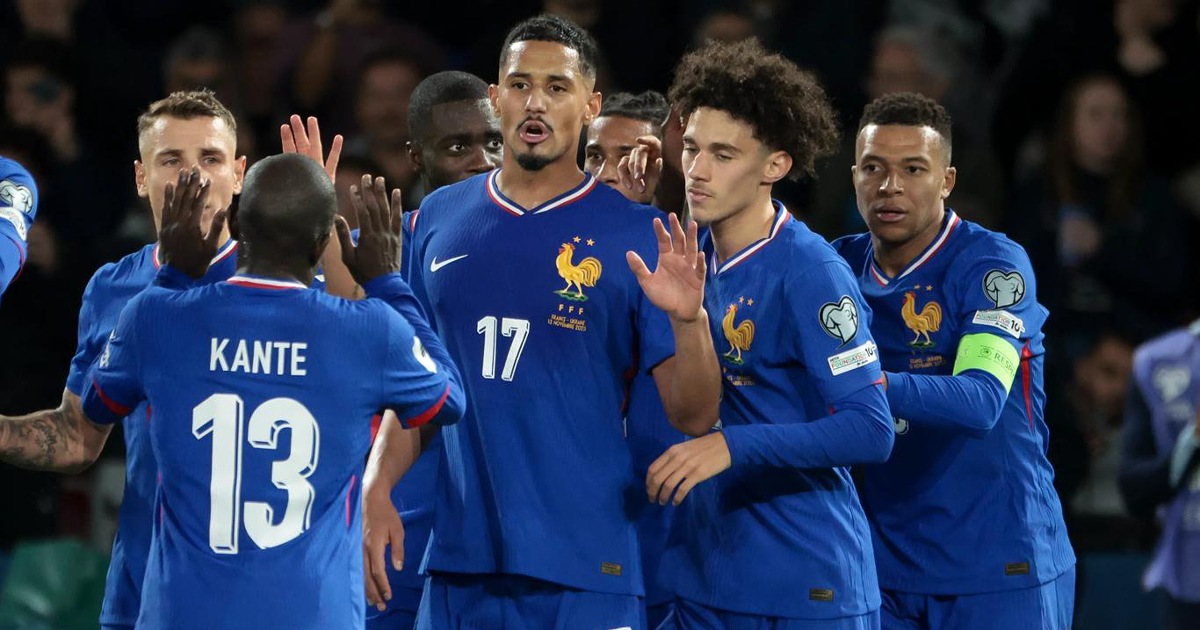
France are the world’s number one ranked team heading into the 2026 World Cup. They have reached the last two World Cup finals. Their squad is the deepest and most expensive in the tournament. And Kylian Mbappe, at 27 and in the absolute peak of his career is the most dangerous individual player in world football right now. This is Didier Deschamps’ final tournament as manager. He wants to leave as a two-time World Cup winning coach. His squad gives him every tool he needs to do exactly that.
Here is France’s strongest possible starting eleven, the lineup that Deschamps is most likely to select when the knockout rounds begin.
Formation: 4-3-3
France’s most effective system under Deschamps combines defensive solidity through a well-organised back four and a midfield double pivot, with the creative freedom of three world-class forwards in the final third. The 4-3-3 gives Mbappe the central role he prefers, with Dembele and Olise providing width and the ability to cut inside and create from deeper positions.
Goalkeeper: Mike Maignan
Club: AC Milan
The frontrunner to win the Golden Glove at this tournament. Maignan currently leads the Golden Glove market as the frontrunner. With France tipped as the side most likely to go the distance in North America, it is no surprise to see him leading the betting. He finished the Serie A season with 13 clean sheets, 108 saves, and 35 goals conceded across 37 appearances. His leadership, his commanding of the penalty area, and his distribution from the back make him the complete modern goalkeeper.
Right-Back: Jules Kounde
Club: Barcelona
One of the most technically gifted right-backs in world football. Kounde’s ability to combine defensively and offensively makes him ideal for France’s attacking system, he overlaps to create two-on-one situations on the right, his crosses are precise, and his recovery pace makes him one of the hardest full-backs to beat in a one-on-one. He is also comfortable in a back three if Deschamps chooses to change systems mid-game.
Right Centre-Back: Dayot Upamecano
Club: Bayern Munich
The aggressive, press-initiating dimension that complements Saliba’s controlled game. Upamecano steps out to win the ball high when France’s press is active, using his physicality and pace to cover the ground between the defensive line and the midfield. When he is commanding, France’s defence is virtually impenetrable. His occasional lapses of concentration are the one risk Deschamps manages carefully.
Left Centre-Back: William Saliba
Club: Arsenal
The best centre-back in the world. Last season with Arsenal, Saliba played more Premier League minutes than any other outfield player and earned a third consecutive spot in the PFA Team of the Season. His calmness under pressure and ability to read the game make him a world-class talent. Saliba’s 92.9% passing accuracy and 125 duels won in the Premier League this season confirm what every analyst already knows, he is the defensive cornerstone of France’s title challenge.
Left-Back: Theo Hernandez
Club: AC Milan
The most attacking left-back at the entire tournament. Theo Hernandez’s pace, his direct running into the opposition half, and his ability to deliver dangerous balls into the penalty area from the left flank give France a constant threat down their left side. Defensively he requires Kante or Tchouameni to cover his advanced positions, but the attacking returns he provides justify the risk entirely.
Defensive Midfielder: N’Golo Kante
Club: Galatasaray
The player who makes every other player around him better. Kante’s ability to break up attacks before they develop, to recycle possession cleanly, and to cover the ground left by Theo Hernandez’s forward runs is the invisible glue that holds France’s system together. At 35, he is no longer the player who covered every blade of grass, but his reading of the game is so elite that he does not need to. He is the key architect of France’s 2018 World Cup glory and plays a similar role here.
Central Midfielder: Aurelien Tchouameni
Club: Real Madrid
Tchouameni’s combination of physicality, technical quality, and intelligence in both defensive and offensive phases makes him the ideal partner for Kante in France’s midfield. He covers the defensive space that Kante does not fill and provides a progressive passing option that moves France forward quickly. His long-range shooting is also a weapon that opponents cannot ignore.
Attacking Midfielder: Eduardo Camavinga
Club: Real Madrid
The third midfielder who connects France’s defensive unit to their attacking trio. Camavinga’s dynamism, his ability to carry the ball through midfield under pressure, and his late arriving runs into the penalty area give France an additional goal threat from deep. He is one of the most complete all-around midfielders in European football and his inclusion pushes France’s midfield quality to a level no other team can match.
Right Winger: Ousmane Dembele
Club: PSG
The reigning Ballon d’Or winner. Dembele has come of age under Luis Enrique in Paris and enters the tournament with an assurance he has not always had. There is no one more deadly with both feet, and it would be a big surprise if he does not score his first World Cup goal in North America. His 35 goals and 14 assists for PSG this season confirm that his peak years have arrived at exactly the right moment.
Striker: Kylian Mbappe
Club: Real Madrid
The captain. The Golden Boot favourite. The man four goals away from Miroslav Klose’s all-time World Cup scoring record. Mbappe at 27 is at the absolute peak of his powers, faster than anyone alive, more clinical than any striker in the tournament, and with the experience of two World Cup finals already behind him. He is the frontrunner to win the Golden Boot at +600. Everything France do leads back to him. His positioning, his finishing, and his penalty-taking make him the most complete attacker at this entire tournament.
Left Winger: Michael Olise
Club: Bayern Munich
The most underrated player in France’s squad and the man most likely to emerge from this tournament as a global superstar. With 22 goals and 26 assists in all competitions for Bayern Munich this season, Olise possesses the kind of all-round attacking threat that can light up the World Cup. Deschamps described him as “technically gifted, runs a lot, and moves cleverly.” He finishes in the top ten of the Bundesliga for almost every attacking metric. Playing alongside Mbappe and Dembele, he is both harder to stop and harder to notice — until he scores.
Key Tactical Points
France’s strength in this system is their ability to attack from anywhere. Mbappe operates centrally but drifts left to exploit the space Theo Hernandez vacates when he pushes forward. Dembele cuts inside from the right onto his left foot. Olise comes inside from the left. Tchouameni and Camavinga arrive from deep. France create danger from eight different positions simultaneously — making them virtually impossible to defend against as a single defensive structure.
The primary vulnerability is the high defensive line. France press high and leave space behind for opponents to run into. Teams with genuine pace in behind, Argentina, Brazil, Norway will target that channel. Saliba’s reading of the game compensates for this better than any other defender could, but one moment of misjudgement in a knockout game could prove costly.
Deschamps also has extraordinary depth. Rayan Cherki, Bradley Barcola, and Marcus Thuram all sit on the bench, players who would start for almost any other nation in the tournament. France’s second eleven is better than most teams’ first.
The bottom line: France’s strongest XI is the most complete lineup in the tournament. If Deschamps can manage the squad’s personalities, keep the key players fit, and trust his system in the knockout rounds, this is his farewell trophy.
Sources: Ladbrokes, Bundesliga, FOX Sports, Sports Illustrated, Tips GG